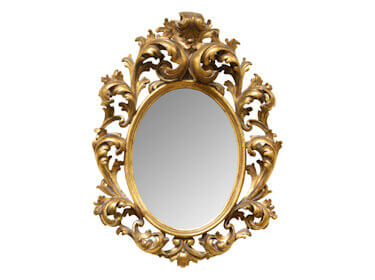

Mirrors have a long and noble history with the oldest surviving being over 8000 years old and made of polished Obsidian (volcanic glass). For thousands of years the necessary reflective quality was created using polished metals or stones, but in the 16th Century a new finish was invented using a mercury and tin amalgam. At the time Venice was the centre for such Mirror production with this new technique was initially kept a closely guarded secret. Extremely hard to make in large sheets, most early mirror frames instead incorporated smaller plates joined together. Large mirrors only became possible in the late 18th Century and were prohibitively expensive for all but the elite.
Today a mirror is just as important in any room as in the past bringing light and elegance. Of course, there are many different forms from wall mirrors or Overmantle mirrors to dressing mirrors and handheld. However whichever you decide on, there is nothing that beats the character of antique and vintage examples. At LoveAntiques you will find amazing old mirrors of all sorts for all your needs.
Lorna Byskou
Victorian Gilt Overmantle Mirror
£ 1,350
Lorna Byskou
Victorian Gilt Triple Plate Overmantle
£ 1,650
Lorna Byskou
Victorian Gilt Arch Top Overmantle Mirror
£ 895
Dave Fry
Deco Star Mirror
£ 280
Elmgarden Antiques
Very Large Victorian Overmantel Mirror
£ 1,400
Dave Fry
Antique Portrait Fret Mirror
£ 290
Church Street Antiques
19thc Giltwood and Sand Moulded Gesso Framed Mirror
£ 950
Jeff Sims Antiques
Rare Silver Campaign Travelling Shaving Mirror
£ 155
Worboys Antiques
Mirrored Beechwood Wall Rack
£ 265
£ 299
Worboys Antiques
Walnut Queen Anne Style Cheval Mirror
£ 475
Georgian Antiques
Gilded Convex Mirror
£ 700
CES Home & Garden Limited
Vintage Gilded Mirror
£ 75
Worboys Antiques
Small Oval Beech Wood Wall Mirror
£ 225
Worboys Antiques
Black Chinoiserie Oval Wall Mirror
£ 265
£ 119
Worboys Antiques
Oak Arts & Crafts Wall Mirror
£ 175
Worboys Antiques
Large Edwardian Mahogany Oval Wall Mirror
£ 165
Town House Traders Ltd
Antique Walnut Cheval Dressing Mirror
£ 275
Elmgarden Antiques
An Arts and Crafts Poker Work Wall Mirror
£ 425
Town House Traders Ltd
Large Gilt Framed Sun Burst Mirror
£ 350
Elmgarden Antiques
Beautiful Arts & Crafts Oval Copper Wall Mirror
£ 475
Elmgarden Antiques
Art Deco Blue Oval Mirror
£ 375
Hendle's Hoard
Early Brutalist Solid Cast Bronze Wall Mirror – c.1940s
£ 275
Fernyhough Antiques Ltd
French Gilt Trumeau Mirror
£ 995
Antikki Interiors
Regency Mahogany Table Dressing Mirror
£ 375
Antikki Interiors
Victorian - Edwardian Oval Mirror
£ 295
Antikki Interiors
Georgian Toilet Table Mirror
£ 495
Elmgarden Antiques
Victorian Inlaid Walnut Overmantel Mirror
£ 550
Elmgarden Antiques
Gilt and Lacquer Regency Style Convex Wall Mirror
£ 650
Burgett Langfield
English Art Deco Peach Coloured Overmantle Mirror
£ 695
Victoria Antiques
Stylish Vintage Venetian Style Mirror
£ 360
Millers Antiques
Oak Hall Mirror with Shelves
£ 230
Debenham Antiques Ltd
Mid Century Swedish Segmented Portrait Wall Mirror
£ 1,550
JMR Antiques Ltd
English Georgian Carved Gilt Wall Mirror
£ 1,995
Worboys Antiques
Cut Glass Frameless Wall Mirror
£ 145
£ 245
Late 19th-century Mahogany Table Top Dressing Mirror, c.1880–1900 (Victorian)
£ 245
Leeds Antiques
Rams Head Antiques
Attractive 19th Century Brass Wall Mirror
£ 485
Debenham Antiques Ltd
Large Scandinavian Mid Century Segmented Wall Mirror
£ 1,595
Debenham Antiques Ltd
Mid Century Arched & Etched Mirror by Glas & Tra
£ 1,450
Vintage and Antique Mirror FAQs
How can you tell if a mirror is old?
There are several ways to tell if a mirror is or not. The first is to look at the mirror plate itself. Mercury Mirrors first began to be used from the 16th Century and used thicker glass than today. You can gauge the glass thickness by placing an object like a pen or coin against the glass and spot the depth of the gap before the reflection begins. The mirror will also ‘sparkle’ and create a softer image than modern mirrors. Silver backed mirrors emerged in 1835 and the mirror has a slightly more yellow tint overall than new examples. Older mirrors are more liable to have imperfections and losses to the silvering. Modern mirrors are backed in a tin foil which produces a very crisp image. You can often also date a mirror from the frame, but it is important to recognise that old mirrors regularly get new mirror plates and old mirrors can be put into modern frames. Many people today ‘age’ modern mirrors using paint or artificial wear, but these can usually be differentiated from genuine old examples.
What different types of mirror are there?
As a loved item in any home there are many forms and styles of mirror, although they are all for the same basic purpose. The most common types are convex mirrors (which are domed outwards and display a wider field of view than usual) and flat mirrors. Those placed above the fireplace and have a flat base are called Overmantel mirrors, while those originally intended to be hung over a side table are called Pier mirrors. Depending on the size there are several names for mirrors with their own stand. These are commonly called Cheval or Swing mirrors if they tilt and Toilet or Dressing mirrors if they were intended to be placed on top of a table or chest. Hand mirrors are held in the hand as the name suggests.
How much do Antique mirrors cost?
Like any piece of antique furniture antique and vintage mirrors can vary dramatically in price. This can be due to the size, look, rarity and overall desirability of the piece. Generally larger more grand mirrors always command more money than smaller because they are status symbols for wealth and antique examples are usually (with some exceptions) more valuable than vintage or modern mirrors. When purchasing a mirror online it is important to consider the shipping to yourself as this can be prohibitive. Most postal companies will not offer compensation for damage and personal couriers will often charge a slight premium for the extra care required. This is why it is worthwhile buying from our reputable dealers on LoveAntiques as they usually sort the delivery for you.
How to antique a mirror?
Many people today enjoy mirrors which appear weathered and worn as occurs naturally over time with antique silvered or mercury mirrors. While nothing beats original worn mirror plates, this is not always possible so weathered effects are created instead. There are lots of videos and descriptions online for how to ‘age’ a mirror but there are basically two approaches. The first is to take a modern mirror and create gaps and flaking to the foil backing using cleaning products, paint stripper and abrasives such as wire wool. These gaps are then accentuated with dark paint. The second approach is to begin with a clear sheet of glass and build up a weathered mirror look using layers of mirror-effect spray paint and an oil or washing up liquid to create natural defects and spots. Either approach can be quite effective and create a unique look.